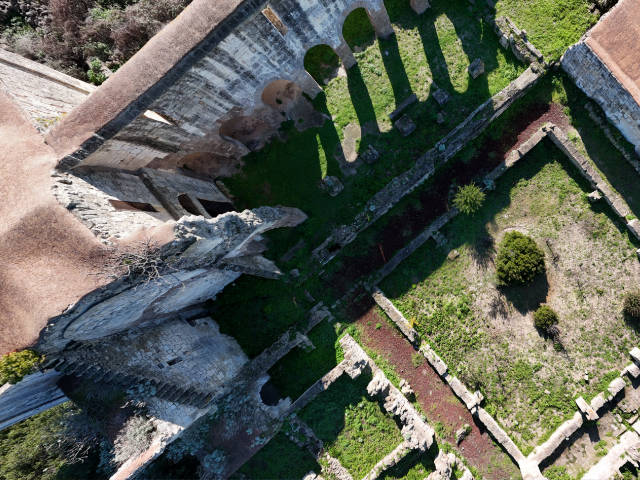
You enter the land between Uri and Ittiri and the landscape changes its rhythm. The hills soften, then suddenly give way to harsh, exposed ridges of pale, sharp-edged limestone. It is here, along an ancient Roman route—once known as s’istrada de sos Padres—that you come upon the remains of the Abbey of Our Lady of Paulis.
You walk among stones that speak of a deliberate choice. This place, originally marshy, was entrusted in 1205 by Comita II, King of Torres, to the Benedictine Cistercian monks. They were given a task that was both practical and symbolic: to reclaim the land and build a community. From the marsh comes the name Paulis, and from the marsh an abbey was born.
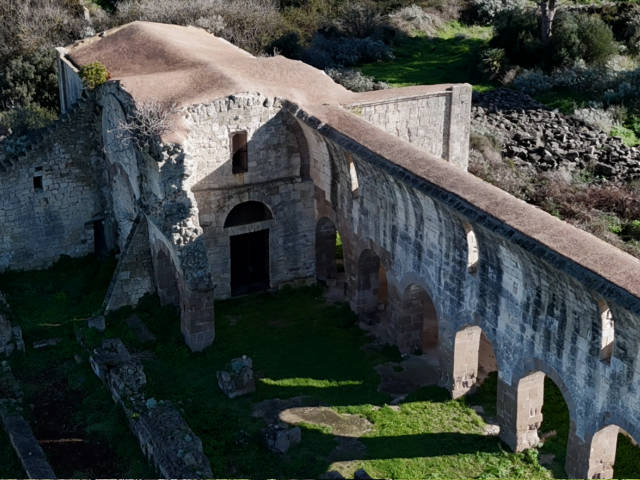
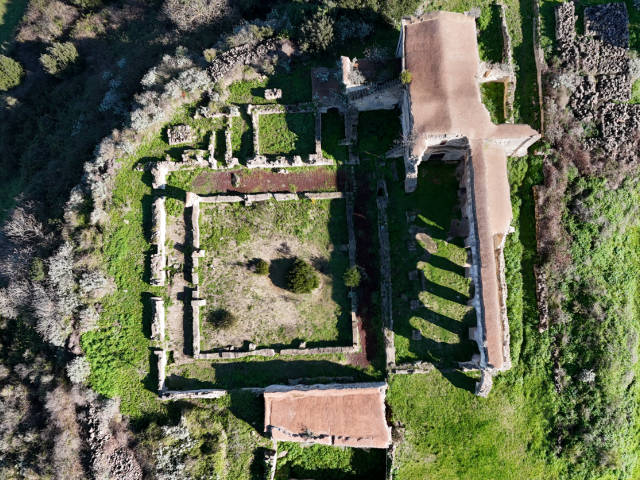
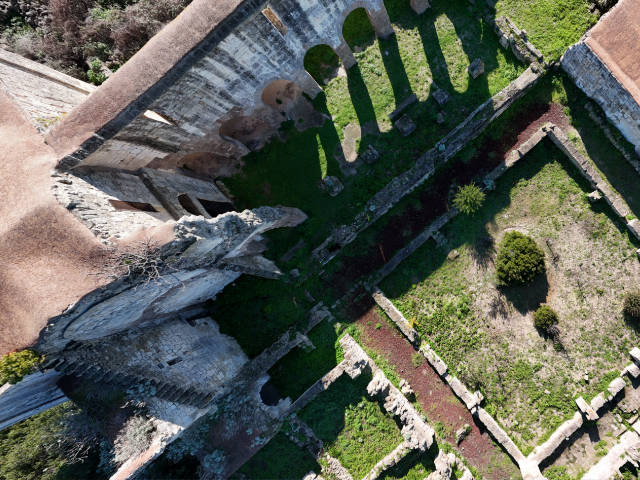
Before you lies what remains of a complex that was alive for centuries. The church, built of local limestone, followed the severe, measured style of the Cistercian workshops active in Sardinia between the 12th and 13th centuries. It was laid out in the form of a commissa cross: three naves marked by arcades resting on pillars, a slightly projecting transept, lateral chapels, and a square presbytery. The spaces were covered by barrel vaults, conceived to welcome silence and amplify it.
As you look more closely, you begin to recognize details that speak of symbolism and orientation. In the perfectly aligned apse, a Latin cross-shaped window once opened; on the opposite side stood a liturgical cupboard. On the eastern side of the choir, a bifora surmounted by a monofora—an explicit reference to the Trinity—housed a panel bearing a Greek cross.
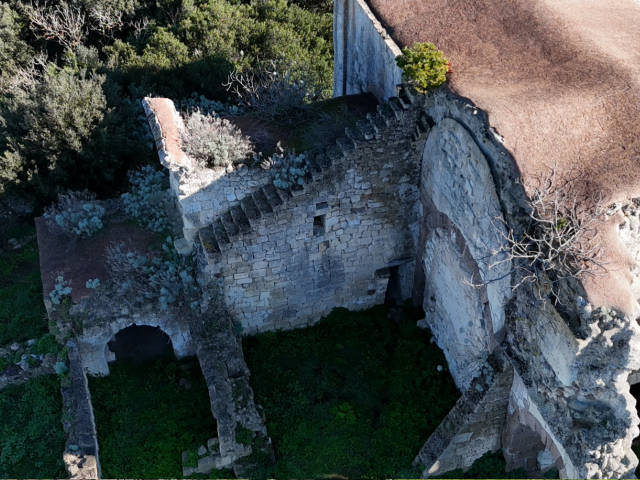
The monastic community remained active until the 15th century. Then came abandonment. By the 19th century, the abbey had already been reduced to a ruin. What you see today is the result of successive restoration campaigns: the choir, part of the transept, the chapels, six arcades of the central nave, and sections of the perimeter walls. Around the main building, the remains of the cloister and conventual spaces still trace the layout of a daily life shaped by work, prayer, and discipline.
Here you do not find a reconstructed monument. You find a presence. Stone, emptiness, and the light filtering through the arches tell you more than any words what it once meant to inhabit this place.
Chronology: 13th century AD
Sign up for our newsletter to receive updates on news and events.
Via Enrico Toti, 20
07034 . Perfugas (SS) . Sardinia . Italy
CF 9103980090


Project realized through the PSR Sardinia 2014-2022. Measures 19 “Local development support LEADER” – Submix 19.2 Support for the execution of operations under the strategy local participatory development “System actions” - Question Support: 34250295986 - CUP H38J23000360009